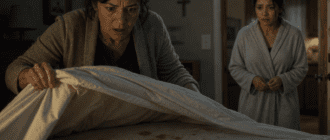

«Dios salvó a este mundo de tu sangre», susurró mi suegra mientras se inclinaba sobre el pequeño cuerpo inmóvil del bebé.Las palabras no sonaron como una oración. Sonaron como una sentencia.
I stood frozen in the center of Winthrop’s private maternity wing, a place that felt more like a cold marble museum than a hospital. The air carried the scent of expensive, delicate lilies mixed with the sharp chemical bite of antiseptic. My husband, Mark, had his back turned to me, staring out at the manicured grounds beyond the window, his shoulders slumped in a posture of quiet surrender.
Then a soft voice cut through the suffocating silence.
“Mom?”
My eight-year-old son, Toby, stepped forward from the corner where he had been ignored for hours. His small hand trembled as he pointed toward the stainless steel nurse’s cart.
“Should I give the doctor the thing Grandma hid in my brother’s milk?”
No one breathed.
This is the story of the day the powerful Winthrop dynasty tried to erase me—and how the innocent words of a child brought their empire crashing down.
To understand the horror of that moment, you have to understand the Winthrops. They didn’t just have money. They had legacy. They treated their bloodline like a purebred breeding program. And I—Elena, a former pediatric nurse from a rust-belt town—was the genetic flaw in their perfect design.
When I married Mark, I believed I was marrying a man, not a trust fund. But his mother, Margaret Winthrop, made it clear from our wedding day—when she wore white—that I was nothing more than a temporary biological vessel. A necessary evil to produce an heir.
When Toby was born, he had my eyes and my chin. Margaret barely tolerated him. But when I became pregnant with Leo, she grew obsessed.
“We need a real Winthrop,” she would say, staring at my belly with a mixture of hope and disgust.
The labor was difficult. The doctors in the private wing were all paid by the Winthrop fortune. When Leo was born, he cried—pink and perfect. I held him. I fed him.
Then they took him to the nursery for “routine monitoring.”
Two hours later, the room was silent. No monitor beeping. No movement.
The doctor—Dr. Evans, a man with damp hands and restless eyes—told me it was SIDS. Sudden. Unexplained. Tragic.
But it didn’t feel tragic.
It felt staged.
I reached for Leo. His tiny body was still warm. My tears soaked into the sterile, high-thread-count sheets. The pain wasn’t just emotional—it was physical, crushing the air from my lungs.
Margaret stood at the foot of the bed.
She wasn’t crying.
Her face was a polished granite mask, her silver hair perfectly arranged. She leaned closer, her breath smelling of mint and expensive gin, and whispered:
“God saved this world from your blood. This… mistake… was never meant to carry the Winthrop name.”
Behind her stood my sister-in-law, Sarah—a perfect imitation of her mother. She nodded silently, glancing at her watch as if my son’s death were nothing more than an inconvenience to her morning schedule.
“Mark?” I choked, searching for him. “Did you hear what she said?”
He didn’t turn.
He stared out the window, his reflection pale and ghostlike.
He was choosing.
And he wasn’t choosing me.
He was choosing legacy.
Approval.
The path of least resistance.
“You can try again, Elena,” Margaret said calmly, adjusting her jacket. “Perhaps with a surrogate next time. Someone who can produce… a better child.”
A scream rose in my throat—raw, ancient, filled with grief and rage.
But before it could escape, the air shifted.
It grew heavy.
Charged.
Toby stepped into the center of the room.
He wasn’t crying.
He looked confused. Frightened. Burdened with a secret far too heavy for his small shoulders. His eyes locked on a discarded baby bottle sitting near the biohazard container on the nurse’s cart.
“Mom?” he said again.
Margaret’s head snapped toward him, her eyes narrowing like blades.
“Toby. Sit down,” she ordered.
“But Grandma,” Toby said, his voice trembling but clear. “You told me to be a big boy. You said it was a secret.”
Margaret took a step toward him.
“Quiet, child.”
But Toby didn’t stop.
He looked at the doctor. Then at me.
“Should I tell them about the special vitamins? The ones you poured into his milk? You said they would help my baby brother sleep forever… but they smelled like the bitter stuff the gardener uses on the rats in the basement.”
Silence fell.
Complete.
Margaret’s face drained of color—not with guilt, but with the shock of being exposed.
Sarah gasped, her hand flying to her mouth.
For the first time, Mark turned around.
His face was pale with horror.
“Mother,” he whispered. “What is he talking about?”
Toby didn’t wait for an answer.
He walked to the cart and pointed at a small glass vial half-hidden beneath folded gauze.
“This. She took it out of her purse. She said I was a good helper.”
My grief vanished.
In its place rose something colder.
Something sharper.
The nurse inside me—the one I buried to become a Winthrop wife—came back to life.
Rat poison.
Anticoagulants.
Or something worse.
Cifrat…
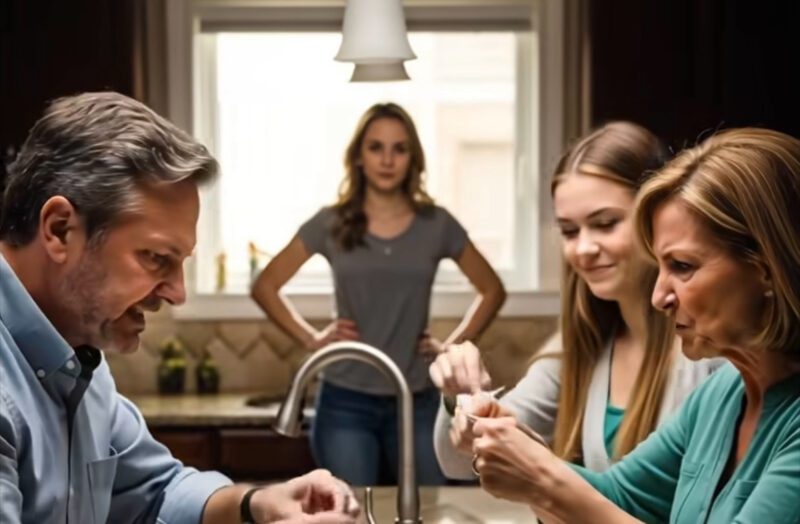
Margaret recovered her composure with terrifying speed. She strode toward Toby, her heels striking the floor in sharp, aggressive beats. Her voice dripped with artificial sweetness, like a predator imitating a lullaby.
“Toby, darling, you’re confused,” she murmured, reaching to grasp his arm. “You saw Grandma putting sugar in the milk because hospital formula tastes dreadful. You had a bad dream, sweetheart. Grief makes us imagine terrible things.”
She glanced at Dr. Evans, her eyes hard as flint. “My grandson is in shock. He has an active imagination. I suggest we transfer the body to our private funeral director immediately—before this hysteria spreads.”
I moved.
I didn’t run. I didn’t stumble.
I crossed the room in two steps and placed myself between Margaret and my son. I pushed her hand off Toby’s shoulder.
“Don’t touch him,” I said. My voice wasn’t a scream. It was low. Controlled. “If you touch my son or that cart again, Margaret, I will kill you.”
She stepped back, staring at me as if a piece of furniture had suddenly begun to speak.
“Elena, control yourself. You’re embarrassing the family.”
“Doctor,” I called out without taking my eyes off her, “if that vial leaves this room before the police arrive, I will drag this hospital back to the Stone Age. I want a full toxicology panel on my son. Immediately. And I want law enforcement here.”
Dr. Evans looked trapped. Yes, he was on their payroll—but he was also a man who understood when a situation crossed the line from influence to criminal liability. His pen slipped from his fingers. The metallic clatter echoed like a gunshot in the silent room.
“Mrs. Winthrop,” he stammered, looking at Margaret, “if the boy insists he witnessed tampering—”
“He’s a child!” Sarah snapped, finally finding her voice. “He doesn’t know what he’s saying. Look at him—he’s traumatized.”
Mark stepped forward, hands raised in a calming gesture.
“Elena, please. Think about what you’re saying. You’re accusing my mother of… this? That’s insane. Let’s just go home. We can grieve privately. We don’t need police involved.”
I looked at my husband—really looked at him—for the first time in years. I saw the weakness in his jaw. The fear in his eyes. Not fear for our dead son.
Fear of scandal.
“There is no ‘we’ anymore, Mark,” I said. “Toby, come here.”
I pulled my son close.
“Did she tell you to touch the bottle, sweetheart?”
Toby nodded. The tears finally fell.
“She made me shake it. To mix the vitamins.”
My knees nearly gave out.
She had placed his fingerprints on the weapon.
She had made an eight-year-old her insurance policy in case anything went wrong.
The cruelty was so calculated it stole the air from my lungs.
Dr. Evans reached for the wall phone. “I’m calling security.”
Margaret’s eyes flashed.
She lunged—not at me—but at the cart. She snatched the small glass vial Toby had pointed to and slipped it into her pocket.
“You have no evidence,” she whispered. “Only the ramblings of a distressed child and a hysterical mother.”
But she miscalculated.
She thought I was just grieving.
She forgot I used to run emergency triage.
“You just tampered with evidence in front of three witnesses,” I said calmly, pointing toward the security camera mounted in the corner of the room. Its red light blinked steadily.
Margaret froze.
She followed my finger to the camera.
For the first time, I saw real fear crack through her porcelain mask.
The next ten minutes blurred into psychological warfare.
Margaret shifted tactics instantly. She pulled out her phone and called the family attorney—Arthur Pendleton, a man who had buried more Winthrop scandals than bodies.
“Arthur, come downstairs. Elena is unstable. She’s making outrageous accusations. We need an injunction. Now.”
Sarah moved to the door and folded her arms across her chest.
“No one leaves until Arthur gets here.”
I ignored them.
I walked to Leo’s bassinet.
I placed my fingers gently against his neck.
He was cool—but was he cooling too fast? Or too slowly?
The nurse in me was fighting the mother in me.
“Dr. Evans,” I said sharply, “why hasn’t there been a code called? He’s been ‘gone’ for two hours.”
The doctor was sweating now, wiping his forehead with a trembling handkerchief.
“Infants are different, Elena. You know that.”
“I know poison can mimic death,” I replied. “I know certain toxins slow the heart until the pulse is nearly undetectable. Did you check his carotid for a full minute? Or did you listen for five seconds and make a declaration because Margaret Winthrop told you to?”
Dr. Evans went pale.
Mark grabbed my arm.
“Elena, stop. You’re desecrating his memory.”
“I’m trying to save his life,” I shouted, pulling away. “Check him again. Now.”
Margaret gestured sharply to Sarah.
“Remove the cart. Immediately.”
Sarah shoved the door wider and lunged for the stainless steel cart.
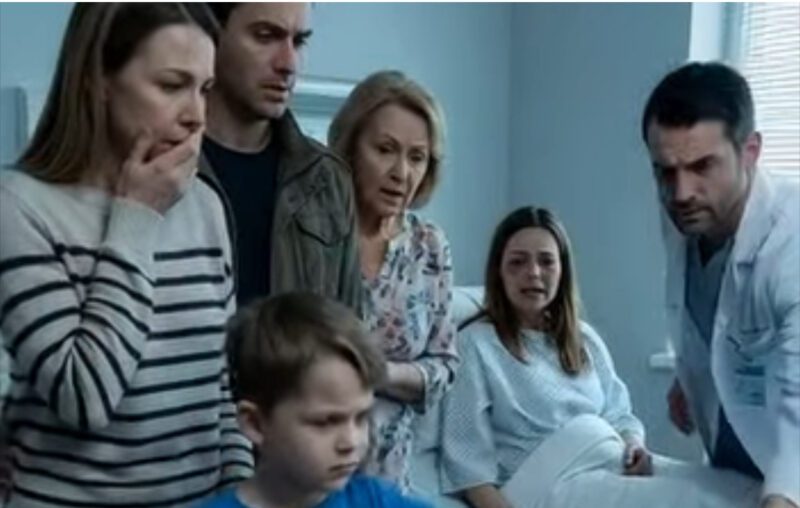
«¡No!», grité, pero la camilla me presionó.
En ese momento, la puerta de servicio al fondo de la habitación se abrió. Entró una enfermera, una mujer que no reconocía. No llevaba el uniforme pastel típico del personal de Winthrop. Vestía de azul oscuro.
No dijo una palabra. Fue directamente hacia la camilla, agarró el asa y comenzó a empujarla hacia la salida de servicio.
«Por fin», suspiró Margaret, suponiendo que era la limpiadora a la que había llamado por SMS. «¡Llévensela de inmediato! ¡Completamente!»
La enfermera se detuvo junto a la puerta. Me miró por un instante; sus ojos se clavaron en los míos. Había algo tenso en su mirada. ¿Un gesto de advertencia? ¿O una señal de alerta?
«¡Esperen!», grité. «¡Esta es la prueba!»
Saren rió, un sonido agudo y burlón. Se inclinó hacia mi oído; su perfume me embriagó. «¿Crees que has ganado, Elena? Las “pruebas” no existen. Arthur estará aquí en cinco minutos. Esta noche, Leo será desposeído, y tú terminarás bajo cuidado psiquiátrico por poner a Toby en peligro con tus delirios».
Observé cómo la enfermera desaparecía con la camilla. Mi corazón latía en mis costillas. ¿Acaso me estaba volviendo loca? ¿La influencia de Margaret había alcanzado ya al personal de limpieza?
Toby tiró de mi blusa. «Mamá… esa señora… me hizo un guiño».
Lo miré. «¿Qué?»
«La enfermera… me guiñó un ojo».
Antes de que pudiera procesarlo, el Dr. Evans, que finalmente se había atrevido a revisar a Leo de nuevo, jadeó.
Era un sonido húmedo y áspero.
«Dios mío», susurró.
Arrojó su estetoscopio.
«¡Hay pulso!»
La habitación estalló.
Margaret gritó, inhumana. «¡Imposible!»
El Dr. Evans gritaba códigos locamente por el teléfono de la pared. «Código azul. Estadísticas de la UCI. Ritmo débil. Posible sobredosis. ¡Traigan una camilla de emergencia!»
Leo no estaba muerto. Luchaba. Las “vitaminas” no lo habían matado; habían deprimido su cuerpo hasta un estado casi letal, y ahora, cuando la dosis empezaba a metabolizarse, su corazón intentaba latir de nuevo.
Los equipos médicos irrumpieron por la puerta principal, apartando a Saren y a Mark. Se reunieron alrededor de la pequeña cama infantil. Retrocedí un paso, abrazando a Toby, observando cómo trabajaban sobre mi pequeño hijo grisáceo.
«¡Necesita antídoto!», gritó uno de los residentes. «¿Qué ha ingerido? Tenemos que identificar el veneno».
Margaret permaneció apoyada contra la pared, las manos en los bolsillos donde había ocultado la jeringa. No dijo nada. Planeaba dejar que muriera. Preferiría que su nieto muriera sobre la mesa antes que confesar su crimen.

«¡Digoxina!», gritó Toby.
El silencio volvió a apoderarse de la habitación.
«¿Qué?», preguntó el residente principal, mirando al niño.
«El frasco», dijo Toby con claridad. «Decía “Ez porrel”. Lo recuerdo porque suena como “ez porrel”».
El rostro de Margaret se oscureció. Sabía que Toby era inteligente. No había considerado que él pudiera leer etiquetas que, en su mente, estaban fuera de su alcance.
«¡Voy a administrarle DigiBind!», gritó el doctor.
Mientras el equipo médico trabajaba para eliminar el veneno del cuerpo de Leo, la puerta de servicio trasera se abrió nuevamente.
No era personal de limpieza.
Era la enfermera de azul oscuro. Detrás de ella venían dos policías estatales uniformados y una mujer con un impecable traje gris.
«La enfermera», señaló hacia Margaret, «es ella».
Margaret se enderezó, intentando invocar todo el peso del nombre Winthrop. «¿Quién crees que eres? ¡Has robado propiedad del hospital!»
La mujer del traje gris dio un paso adelante. «De hecho, señora Winthrop, soy la detective Miller de la oficina del fiscal del distrito. Y esta “enfermera” es mi colega. Hemos estado investigando durante semanas los casos de sustancias controladas desaparecidas de la farmacia del hospital. Observamos las cámaras del pasillo y vimos cómo administró el frasco a su nieto».
Le mostró una bolsa plástica con evidencia. Dentro estaba la botella de fórmula que habían sacado de la camilla.
«Recogimos la camilla», dijo la detective Miller. «Revisamos los residuos de campo: niveles mortales del medicamento cardíaco».
Margaret miró a Mark. «Haz algo. Llama a Arthur».
Mark cayó de rodillas. Realmente se arrodilló, agarrando mi falda y llorando. «Elena, por favor. Podemos arreglar esto. Es un malentendido. No dejes que se lleven a mi madre».
Lo miré. Al hombre que amaba. Al padre de mis hijos. Y yo… no sentí nada. La conexión se había cortado.
«No queda familia, Mark», dije, con voz fría y metálica. «Ya firmé los papeles mentalmente. Y no soy la única a la que temer».
Señalé la pequeña cama infantil de Leo. Un gemido potente llenó la habitación.
Leo estaba vivo.
«Lo hará», dijo el residente, secándose el sudor de la frente.
Margaret intentó huir. Giró y corrió hacia la puerta, apartando a Saren del camino. Pero la policía estatal fue más rápida. Rodearon a la matriarca Winthrop sobre el piso estéril cubierto de linóleo blanco.

Cuando le ajustaron las esposas a sus muñecas, Margaret me miró con ojos llenos de rabia. «No eres nada. Eres suciedad. Nos has destruido».
«No te destruí, Margaret», dije, abrazando a Toby. «Simplemente he vivido más que tú».
El otoño era imponente.
No era solo noticia; era un acontecimiento cultural. Margaret Winthrop, figura pública, fue acusada de intento de asesinato y poner en peligro a un niño. Saren fue acusada como cómplice por intentar destruir evidencia.
El juicio duró tres meses. El testimonio de Toby fue el clavo final en el ataúd. Se sentó en el estrado, pequeño pero valiente, y relató al jurado lo que su abuela había dicho sobre las “vitaminas”.
El nombre Winthrop, que alguna vez fue un pase dorado en nuestra ciudad, se volvió radiactivo. Sus organizaciones benéficas las abandonaron. Sus clubes las prohibieron. Sus activos fueron congelados durante la investigación.
Mark no enfrentó cargos, pero quedó destruido. Se quedó observando, y la gente lo odiaba casi tanto como a su madre. Perdió trabajo, reputación y familia.
Yo presenté la demanda de divorcio, custodia completa y compensación. Contraté a una abogada formidable, una mujer que había crecido en la pobreza y detestaba a hombres como Mark. Tomamos todo: la casa, los fideicomisos, las acciones.
Pero el dinero no importaba. Lo importante era Leo.
Tuvo arritmia cardíaca durante algunos meses por los efectos prolongados del veneno, pero era un luchador. Se convirtió en ruidoso, vivaz y feliz.
Seis meses después de la condena, estaba de pie en la corte. Margaret acababa de ser sentenciada a veinticinco años. Débil, impura y arrogante, fue llevada al microbús. Esta vez no gritó. Solo bajó la vista, derrotada.
Los periodistas me rodearon con micrófonos. «¡Elena! ¿Declaración? ¿Qué dices sobre las acusaciones de los vínculos sanguíneos de los Winthrop?»
Senté a Leo en mi regazo y tomé firmemente la mano de Toby. Miré directamente a la cámara.
«Hablaban de “sangre pura” como si eso les diera derecho a decidir quién vive y quién muere», dije. «Pero la sangre no es sobre dinero ni nombres. Es sobre el coraje de proteger a los inocentes. Mis hijos llevan mi sangre, y por eso son supervivientes. El legado de los Winthrop termina hoy. El nuestro apenas comienza».
Mientras caminaba hacia el coche, mi abogada me entregó una carta. «Es de Mark. Está en un centro de rehabilitación en el norte del estado. Dice que debes saber esto».
Vacilé y la abrí.
Elena,
Ganaste. Mereces ganar. Pero hay algo que mamá nunca te dijo. La única cosa que la enloquecía.
No soy una Winthrop. Mi padre no era su esposo. Soy fruto de un romance con el conductor. Toda su vida vivió aterrorizada de que esa “impureza” que tanto odiaba fuera en realidad su propia culpa. Te odiaba porque eras auténtica, mientras ella vivía en la mentira.
Perdóname.
– Nathan
Miré la carta. La obsesión de Margaret con la “sangre pura” era un reflejo de su propia culpa. Intentó matar a mi hijo para “proteger” un linaje que ni siquiera existía.
Arrugué la carta y la tiré a la basura. Ya no importaba.
Cinco años después.
El sol entra sobre una pequeña y hermosa casa junto a la playa. Lejos de la ciudad, lejos de los mármoles de la mansión Winthrop.
Leo tiene cinco años hoy. Corre entre la hierba alta persiguiendo a un golden retriever. Vivo, fuerte y ruidoso.
Toby tiene ahora trece años. Alto, silencioso y bondadoso. Quiere ser médico. Dice que quiere escuchar a los niños.
Estoy sentada en el balcón, observándolos. El aire huele a sal y rosas silvestres, no a lirios ni antiséptico.
Recuerdo aquel susurro en el hospital: «Dios salvó a este mundo por tu sangre».
Tenía razón. Dios, el destino, la suerte, o la furia de una madre salvó al mundo a través de su linaje. Cortó la corrupción de los Winthrop y permitió que algo nuevo creciera en su lugar.
Mi teléfono suena. Es un mensaje de la fundación que creé, “Proyecto Leo”, que protege a niños en litigios contra familias poderosas. Acabamos de ganar otro caso. Otro niño seguro.
Leo corre hacia mí con una semilla germinada en la mano. «Guarda este deseo, mamá».
Miro a mis hijos. Miro la vida que construimos sobre las cenizas de la traición. Sé que no necesito nada más. Lo tengo todo.
«Quisiera», digo, soplando las semillas al viento, «que ambos siempre sepan lo fuertes que son».
Mientras las semillas se dispersan, brillando doradas bajo el sol, veo una figura caminando por la playa. No es Mark. Él es un recuerdo distante. Es Nathan, el detective que trabajó en el caso con la detective Miller. Viene los domingos a cenar. Me mira como si yo fuera la heroína, no la víctima de la genética.
Me levanto y camino hacia él, dejando las sombras del pasado atrás. Margaret Winthrop se pudre en su celda, guardando el legado de mentiras. Yo estoy bajo el sol, viviendo el legado de la verdad.
Y esa es la única victoria que importa.